
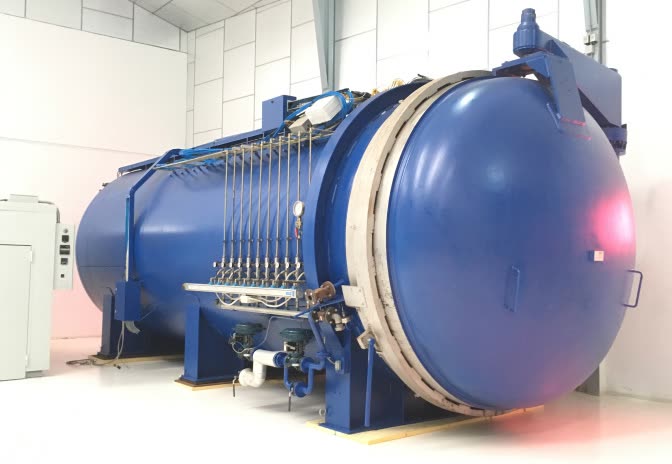
Autoclave curing of carbon fiber parts: capabilities and limits.
Short answer: an autoclave like ours, 3 m in diameter with 8 m of usable length, takes very large parts, but the real limit is set by the mold, the tooling that supports it and the material's cure cycle. Here is the explanation, with numbers. (Our autoclave is being commissioned and we activate it per project; today we cure prepreg out of autoclave in an oven.)
Carbodynamic engineering team · Published on
What an autoclave does and why it makes better parts
An autoclave is a heated pressure vessel. The part goes in laid up on its mold and sealed in a vacuum bag; inside, it is heated following the cycle the resin requires while external pressure is applied to the bag.
That pressure, added to the vacuum, compacts the plies against the mold, drives out trapped air and reduces porosity. The result is a laminate with more fiber and less resin, stiffer and lighter, with a very good surface finish. That is why it is the benchmark process in aerospace and motorsport.
Size: what really fits
The figure usually quoted is the chamber size: in our case, Ø 3 m × 8 m usable length. But the part does not go in on its own: it goes in on a mold, and the mold often sits on a cart or support frame.
To work out whether your part fits, add the thickness of the mold, the support, the bag and the consumables, and check the cross-section of the whole assembly, not just the part. As a rule of thumb, leave clearance around the assembly so hot air can circulate and the temperature stays uniform.
- Long, narrow parts (profiles, beams, blades): make full use of the 8 m
- Wide parts: the limit is the 3 m circular cross-section
- Several small parts: cured together in the same cycle if they share material and cycle
Temperature and cure cycle
Our oven reaches 200 °C, the same as the autoclave when it is in service. That is enough for the vast majority of epoxy prepregs, which typically cure between 120 and 180 °C. Very high-temperature materials (some bismaleimide or thermoplastic resins) require other processes.
What governs is the cycle defined by the prepreg manufacturer: ramp-up, dwells, pressure and cool-down. A cycle can last several hours, so the cost of each cure is spread better when parts are batched together.
When the autoclave is not worth it
The autoclave produces the best part, but it is not always the best option. If the part is not structural, if the run is short or if budget comes first, there are very good alternatives:
- Out-of-autoclave (OOA) prepreg: prepreg quality, cured under vacuum only in an oven
- Resin infusion: large parts without prepreg or autoclave
- RTM: closed mold, two finished faces and good repeatability
| Process | Laminate quality | Mold cost | Size |
|---|---|---|---|
| Prepreg + autoclave | Highest | High (must withstand pressure and temperature) | Limited by the chamber (Ø 3 × 8 m) |
| OOA prepreg | Very high | Medium | Limited by the oven (4 × 2 × 1.8 m) |
| Infusion | High | Low–medium | Very large |
| RTM | High and repeatable | High (closed mold) | Medium |
Prepreg and autoclave
3 × 8 m autoclave being commissioned, available per project; today we cure prepreg in an oven.
TechnologiesOut-of-autoclave (OOA) prepreg
Prepreg quality with more economical molds and cycles, oven-cured.
TechnologiesMolds and tooling
Molds and patterns up to 8 × 3 × 2 m, measured before delivery.
Technical articlesPrepreg, infusion or RTM
A practical comparison to choose the process by part, run size and budget.
Send us your drawing or 3D model, and we’ll bring it to life.
We study your project with the same care you put into designing it, then send you a clear proposal covering process, lead time and price. Only have the physical part? We’ll scan it and take it from there.
What customers ask us most.
What is the maximum part size you can cure in your autoclave?
The usable chamber is 3 m in diameter and 8 m long. The autoclave is being commissioned and we activate it when a project requires it; send us the drawing or STEP file and we will confirm size and lead time.
What temperature does it reach?
Up to 200 °C, the same as our 4 × 2 × 1.8 m oven, which is what we currently use to cure prepreg out of autoclave.
Is the autoclave always better?
It gives the best laminate quality, but for non-structural parts or short runs, OOA prepreg, resin infusion or RTM can be more cost-effective.
Do you also make the autoclave mold?
Yes. We machine and measure it in our plant, in the right material for the cycle's temperature and pressure.