
Carbon fiber orthoses: benefits for orthotists.
Carbon fiber makes orthoses much lighter and thinner than thermoplastic or metal ones, with the same or greater stiffness. Here is where it pays off, what to keep in mind in the design and how we can work together.
Carbodynamic engineering team · Published on
What carbon fiber brings to an orthosis
Carbon fiber has a stiffness-to-weight ratio far higher than the thermoplastics commonly used in orthotics. In practice, that lets you make the part thinner and lighter without losing support.
- Less weight: more comfort and longer wear time
- Less thickness: fits better inside footwear or under clothing
- Controlled stiffness: reinforced only where needed
- Fatigue resistance: withstands thousands of gait cycles
Parts where it makes the most sense
Not every orthosis benefits from carbon. The difference is most noticeable in parts that must transmit loads with little volume, or that the patient wears for many hours a day.
- Ankle-foot orthoses (AFOs) and stiffening insoles
- Knee orthoses and lateral uprights
- Lumbar and back supports
- Splints and holding parts
- Components and sockets for external prostheses
How we work with orthotists
The orthotist knows the patient; we know the material. That is why we always work from your mold, your positive cast or a 3D scan, following your instructions on support points, thicknesses and stiffness.
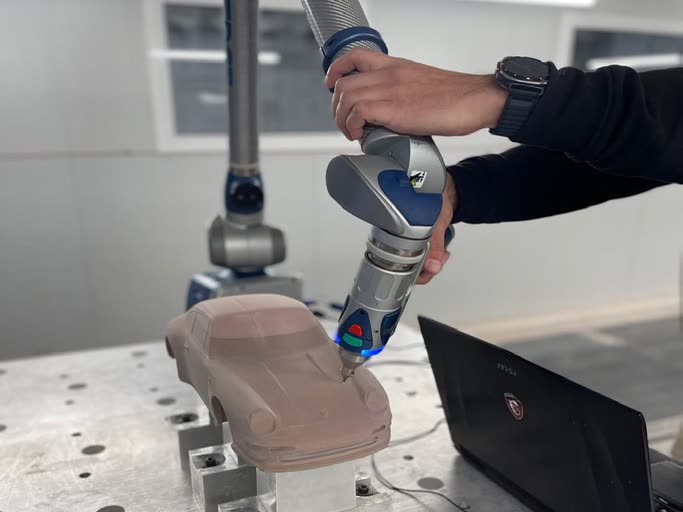
If you do not have a scanner, we can digitize the positive with a FARO arm and store the model to make spare parts or new versions without taking measurements again. We deliver the part laminated and trimmed, ready for you to fit, pad and add the closures.
Send us your drawing or 3D model, and we’ll bring it to life.
We study your project with the same care you put into designing it, then send you a clear proposal covering process, lead time and price. Only have the physical part? We’ll scan it and take it from there.
What customers ask us most.
Is a carbon fiber orthosis more expensive than a thermoplastic one?
Usually yes, because of material and labor. In return it lasts longer, weighs much less and the patient tolerates it better; in many cases the cost per use is lower.
Can a carbon fiber orthosis be adjusted after it is made?
Less than a thermoplastic one, which can be heated and reshaped. That is why it is important to start from a good mold and plan in the design the areas that will be trimmed or padded.
Do you work directly with patients?
No. We work for orthotists, orthopedic technicians, orthotic clinics and manufacturers, who assess the patient and fit the part.